
The United States has engaged in several years of war in Iraq against the Islamic State (IS) since launching Combined Joint Task Force – Operation Inherent Resolve in October 2014. The United States estimates that they have killed more than 60,000 IS members, conducted more than 22,000 airstrikes and trained more than 100,000 security forces throughout Iraq. The successful U.S. campaign is in contrast to past operations in Iraq, Afghanistan, and elsewhere and is best encapsulated in the “by, with, and through” approach of letting Iraqis lead operations. This bottom-up approach is tactically successful but is short on strategy, opening the door for Iranian influence in Iraq. The United States is modeling other counterterror operations throughout the world on its Iraq success with other “build partner capacity” programs. Based on two years of fieldwork and interviews, this article examines both the tactical successes and policy implications of the U.S. successes against IS in Iraq.
CALIPHATERS: A CONTEMPORARY MILLENNIAL MOVEMENT

In 1400 AH (1979/80 CE), a new Muslim apocalyptic millennial movement began and has since gained great momentum. Caliphaters are defined by their millennial goal-world conquest-and the apocalyptic timetable-in this generation; they operate on two major registers: kinetic war (jihad) and cognitive war (da’wa). The movement expanded greatly at the turn of the Western millennium (2000 CE), with the Western news media’s coverage of the “second intifada” (opening round of jihadi war on Western democracies), the U.S. response to September 11. These empowered da’wa campaigns designed to pressure Western infidels into the posture of dhimmi.
CIRCUITOUS RELATIONS BETWEEN MILITARY RESULTS AND POLITICAL OUTCOMES: THE OCTOBER 1973 WAR
This article demonstrates “circuitous but intended outcomes”-or the desirable consequences accurately anticipated and predicted by the actors involved at the moment the act is carried out-in the case of the October 1973 Yom Kippur War between Israel and Egypt. This case provides a strong illustration of how an actor who wages war can circuitously achieve political goals despite suffering military defeat on the battleground. Egypt’s President Anwar al-Sadat astonishingly predicted the indirect results of the war he initiated. Sadat forecast that Egypt needed a spark-“crossing the canal and capturing just ten centimeters of Sinai”-which would trigger the involvement of much more powerful forces, such as the superpowers-and the United States in particular-leading them to successfully compel Israel to withdraw from the Sinai Peninsula, Egypt’s desired goal.
THE SYRIAN CONFLICT: DRIVING FORCES OF BALANCES AND IMBALANCES
At the core of the power struggle among states key to Middle Eastern stability and global balance is the question of who controls whose natural gas flow via whose territories. The United States, Russia, Turkey, Syria, and Iran are analyzed in this context to present how changing alliances have disrupted the regional balance in the Syria conflict. Given the stable hostility between the United States and Russia as well as the steady friendship between Russia and Syria, Turkey’s alliances and enmities are central in the formation of balances. Competition or disagreement between the United States and Russia over Kurdish independence in Syria could lead to a protracted conflict for years to come in the Middle East.
TURKEY’S INTENSIFYING PARTNERSHIP WITH QATAR AND ITS IMPLICATIONS FOR TURKISH-AMERICAN RELATIONS
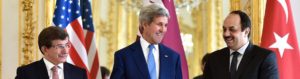
The blossoming of relations between Turkey and the Gulf Cooperation Council (GCC) traces its roots back to the United States-led invasion of Iraq in 2003, which laid the ground for Turkey’s growing involvement in the Gulf. However, Turkish-GCC dialogue has recently transformed into a Turkish-Qatari partnership, concretized largely through a military agreement signed by both nations in December 2014, which paved the way in December 2015 for…
BARRY RUBIN’S LEGACY AND THE STUDY OF U.S. MIDDLE EAST POLICY

Click here for PDF In the following transcript Dr. Martin Kramer recounts his friendship and long acquaintance with Prof. Barry Rubin and their shared interest in U.S. Middle East policy, noting Rubin’s deep concerns regarding the Obama administration in this regard. Also discussed is the administration’s view of the region, contending that it has an […]
- 1
- 2
- 3
- …
- 17
- Next Page »