
At the core of the power struggle among states key to Middle Eastern stability and global balance is the question of who controls whose natural gas flow via whose territories. The United States, Russia, Turkey, Syria, and Iran are analyzed in this context to present how changing alliances have disrupted the regional balance in the Syria conflict. Given the stable hostility between the United States and Russia as well as the steady friendship between Russia and Syria, Turkey’s alliances and enmities are central in the formation of balances. Competition or disagreement between the United States and Russia over Kurdish independence in Syria could lead to a protracted conflict for years to come in the Middle East.
PERSPECTIVES ON TURKEY’S 2017 PRESIDENTIAL REFERENDUM
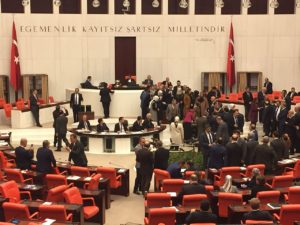
Click here for PDF Until the 1980s, Turkey’s long-standing parliamentarism had precluded debates about presidentialism. In the following decade, the two right-wing presidents, Ozal and Demirel, briefly promoted presidentialism but failed to initiate a system change. However, the Justice and Development Party’s (AKP) 2002 electoral victory ushered in a new period; after over a decade […]
TURKEY’S INTENSIFYING PARTNERSHIP WITH QATAR AND ITS IMPLICATIONS FOR TURKISH-AMERICAN RELATIONS

The blossoming of relations between Turkey and the Gulf Cooperation Council (GCC) traces its roots back to the United States-led invasion of Iraq in 2003, which laid the ground for Turkey’s growing involvement in the Gulf. However, Turkish-GCC dialogue has recently transformed into a Turkish-Qatari partnership, concretized largely through a military agreement signed by both nations in December 2014, which paved the way in December 2015 for…
MOSUL: THE ORIGINS AND FUTURE OF COMPETING AGENDAS OVER RETAKING THE CITY FROM ISIS

Mosul, Iraq’s second largest city, has been a center for Islamic State since its conquest by the group in 2014. The Iraqi government, the United States-led coalition and the Kurdish Regional Government all seek to play a role in its re-conquest and see it as a key to future stability in a post-ISIS …
TURKEY’S CHANGING RELATIONS WITH THE IRAQI KURDISH REGIONAL GOVERNMENT

Since the Iraqi Kurdish rebellion in the early 1960s, Turkish policymakers have perceived Kurdish autonomy in northern Iraq as a major threat to the country’s national security, fearing that the Iraqi Kurdish experience would encourage Turkey’s Kurds to take similar steps towards autonomy and even independence. However, from the mid-2000s onwards …
THE BREAKING UP OF TURKEY’S ISLAMIC ALLIANCE: THE AKP-GULEN CONFLICT AND IMPLICATIONS FOR MIDDLE EAST STUDIES

Click here for PDF Turkey’s Islamic movement increased its power dramatically during the first decade of the 2000s, benefiting from the cooperation of the AKP and the Gulen movement. This alliance allowed Islamic actors to control major state functions following several decades of struggle against secularist elites. Yet, to the surprise of most observers, the […]
- 1
- 2
- 3
- …
- 11
- Next Page »