
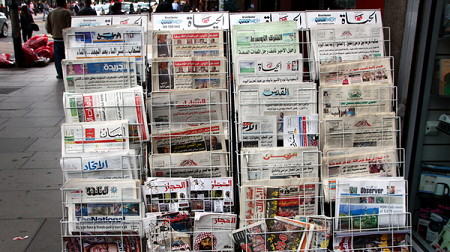
PDF version available here Recent data appear to demonstrate the weakening of the Arab newspapers versus strengthening of the digital media. However, this weakening is less extensive than the corresponding erosion of Western newspapers in their own markets. This study examines the question of how Arab newspapers see themselves. A content and discourse analysis of […]
Now We Know the Truth: What’s Behind U.S. “Peace Process” Policy
By Barry Rubin
At last we have an explanation for what has been going on with Israel-Palestinian talks. It is credible yet ridiculous. And it is very important.
Here is today’s New York Times.
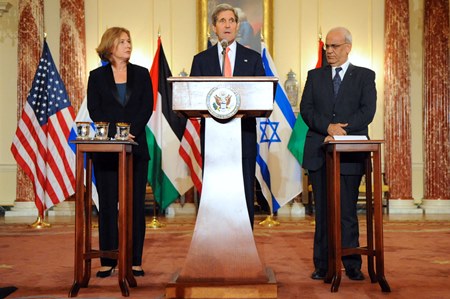
“In recent weeks, Mr. Kerry and his aides have outlined several basic arguments for why his efforts might bear fruit. Perhaps the most important one, which Mr. Kerry advanced almost the moment he was picked for the State Department post, is that the United States does not have the luxury of staying on the sidelines.”
“With the Palestinians poised to take their claim for statehood to the International -For doing so it is not being punished but rewarded.
-The PA will seek statehood not through negotiations with Israel but unilaterally. No Israel agreement will be necessary.
-Note a key assumption here: The United States either will not oppose, or effectively oppose, this effort. Let’s pause here. You mean the United States cannot lead or pressure such countries as Britain, France, Germany, or Italy in saying “”no.” The New York Times doesn’t point out what a failure of Obama Administration influence that would be. Let’s also note the incompetence and failure of that government to stop leading allies at the UN General Assembly to vote for non-member statehood (a non-binding vote) last year despite a one-year warning the PA would try this.
-To summarize, the United States proposes surrender to a development breaking its more than 20-year-long policy that no comprehensive solution would be achieved without real mutual agreement.
-After the “”success” of the unilateral independence for Palestine-remember, with no control of the PA over Gaza-Israel will take action, understandably since it has been sold out by its allies.
-European states, again with no effective action by America, will punish Israel and Israel will be worse off.
Where to begin in analyzing this remarkable foundation for policy?
First, as I pointed out, it presumes incompetence and betrayal by the Obama Administration. It presumes that any battle to block either unilateral independence or punishment of Israel for opposing it would be doomed. This includes a refusal for the United State or European states to punish the PA even while they are believed they will eagerly punish Israel.
Incidentally, this explains Kerry’s seeming slip about Palestine already being an independent country! Will the Obama Administration recognize a state of Palestine not achieved through negotiation with Israel?
Second, it presumes that after everything it has done for 20-40 years has proven to be based on false promises, Israel should base itself on more of such promises.
Third, it presupposes that the punishment would be worse than the risk taken by Israel, and ignores any possible costs faced by the Palestinians. Just because the EU has put sanctions-far looser and less significant than they seem-against special economic privileges for Israeli settlements in Europe does that mean the EU will do major sanctions against Israel in its recognized territory? (If Israel has such indications we don’t know about it and, again, it shows how the United States has not fought against this.
Fourth, it assumes that having been given every reason to believe that they hold all the cards, the PA will make any compromises. This is not likely to result in a deal since Kerry has already told them that in a year or two more they can have anything. Here is Mahmoud Abbas radiating confidence that he is about to get a state. Remember that Kerry’s last Middle East negotiations was when he thought he would easily wean away Syria’s dictatorship from Iran.
And fifth, why would the PA keep any post-treaty commitments? We know that Hamas will not, and that Iran would not accept them. How long before new cross-border attacks and new demands would be made.
I presume that talks would fail and after this explanation of what Kerry is doing I feel even more strongly that this will happen. That’s why the Israeli government has accepted this bad deal, believing-I think accurately-that the PA will make the talks fail. I understand why this option was taken-also because there might be American or European additional threats and promises; nobody can be as bad as Obama in future-but really this tactic is getting tired.
This article is published on PJMedia.
Mideast Media Sampler, David Gerstman, 11/6/12

1) No return? Recently, as Dan Williams reported for Reuters, Mahmoud Abbas apparently gave up his “right of return.” Speaking to the top-rated Israeli television newscast, Abbas was asked whether he wanted to live in Safed, his boyhood town in the Galilee region of what had been British-ruled Palestine and is now northern Israel. “I visited […]
THE ARAB SPRING, ITS EFFECTS ON THE KURDS, AND THE APPROACHES OF TURKEY, IRAN, SYRIA, AND IRAQ ON THE KURDISH ISSUE
This article addresses the approaches of Turkey, Iran, Syria, and Iraq in dealing with the Kurdish issue, with a special focus on historical background. In addition, the article discusses how this issue affects relations among the aforementioned countries and whether cooperation on this issue is possible. The article also examines how the Arab Spring […]
TURKISH-ISRAELI RELATIONS IN THE SHADOW OF THE ARAB SPRING
This article is a short analysis of how Turkey changed under AKP rule so that the regime no longer wished to have an alignment with Israel but, on the contrary, needed to treat Israel as an enemy. In order to understand the initial reasons behind the creation of the Turkish-Israeli alliance, one must also recognize […]
ANTI-ZIONIST AND ANTISEMITIC DISCOURSE ON THE GUARDIAN’S COMMENT IS FREE WEBSITE
The British newspaper, the Guardian, has been described as waging a high-priority campaign against Israel in its pages and on its popular website. Does the evidence available-especially regarding the latter-support this opinion, and if so, in what way does this bias express itself, how far-reaching are its effects and consequences, and what-if anything-can be done to counteract it?